Showing posts with label writing. Show all posts

Monday, August 23, 2010

Mindmap reading: Leo Ou-fan Lee

August 23, Chapter 3 in formation after reading Leo Ou-fan Lee's article "On the Margins of the Chinese Discourse" (1991)

Lee, Leo Ou-fan. "On the Margins of the Chinese Discourse: Some Personal Thoughts on the Cultural Meaning of the Periphery." Daedalus 120.2, The Living Tree: The Changing Meaning of Being Chinese Today (Spring, 1991): 207-226.


Read more...

Back to Mindmaps

First Vision of Chapter 3, August 18

After a long break to participate in a conference and suffer generally from paralyzing anxiety, I'm back to writing.

My anxieties are numerous: I read too slow, I don't work hard enough, I'm not very good at abstract, syncretic thinking. But all of these weaknesses are ones that I can and should be working on. And I am, I think. It is very disappointing to see how little I accomplished this summer, but the only thing to be done, I suppose, is push on, and work harder.

My committee members were very disappointed with my writing, I think, and with good reason. The greatest weakness is that I presented little to no critical voice, and instead presumed to simply channel the voice of Yang Jiang -- this, of course, does not count for much academically. To fix the problem, I decided I needed to write a "treatment" of how the chapter would go and what it would accomplish. It turns out I had already written this "treatment" ; it's called a "prospectus." How stupid I was to have forgotten and ignored my own old writing!

Still, the new "treatment" is considerably more detailed and more sophisticated than the old "treatment." So there is that. And more importantly, this "treatment" ought to serve as a map for the rest of the chapter.

Time to get writing!


Read more...

Tuesday, June 22, 2010

Skrik!

Me today

Today I studiously avoided distractions, but as usual it feels like too little too late. I used the morning to scan half of the French dissertation on Yang Jiang's work, which doesn't look particularly useful but which I should have read through by now. I wrote a fair-ish paragraph introducing my subject and practicing for the AAS panel description I need to write, but I've lost the meaning of the thing. Once again I don't feel confident in the texts I want to study or with what I want to say about them. I'm at sea with my presentation for next Thursday. Sigh.

I did get through "Remembering My Third Aunt"again, and wrote a little bit about it, though the writing lacked soul for the most part. My chapter draft is a huge mess. Tomorrow I'll finish scanning the French dissertation and begin in earnest on the clean-up operation with this bit of writing. Oh, I wish I had given the writing to my teachers before I left for England!
Read more...

Tuesday, June 8, 2010

Retreat Day 9

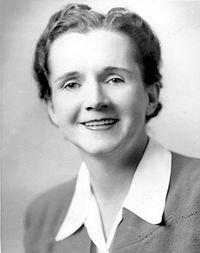
Rachel Carson, who I read a little bit about today

I'm in a worse mood as my writing deadline slips away, my draft seems flimsy and in need of so much more reading, my prospects for getting published look dimmer, and my prospects for ever getting a job look nil.

The worst thing about all this is that it kills the desire to work. Luckily, one great thing about the dissertation retreat is that I know I'm not alone, and there is a palpable energy that comes from having these people working together with me.

I need to breathe, exercise a bit, and then think again. Tonight I'll translate a bit and read. Tomorrow I'll begin by reading 10 more pages of the long essay by Yang Jiang on her father. I'll print out the section I finished today (making the draft 2/9 done) and begin thinking about the way to compress and revise. I think I better bring the book Chinese Reportage with me as well and begin going through that in earnest.

...

Today I took a little time to read from the journal New Literary History. There was an article by Bonnie Foote that I came on by searching for "network theory." It turns out Foote came up with a wide-scope literary theory Foote calls the "interaction model" by thinking through ecocriticism. Suddenly I remembered that Zhao Baisheng said that was his new interest. New Fulbright app, anyone?


Read more...

Wednesday, June 2, 2010

Dissertation Retreat Day 6

The Poet Yu Jian 于坚

Still not dead, as one of my best friends says on his blog. The last week has been devoted to dissertation work in the mornings until 3:30, and my progress has been...distinctly satisfactory, I think. I've almost finished all of the readings I want to do for this chapter of my dissertation, and today the mean time I have created a really substantive outline. Tomorrow I will devote myself to choosing the passages that I will use.

Meanwhile, translation work continues apace. Here's my version of a poem by Yu Jian called "Death Scene for a Butterfly."

A butterfly died in the rainy season     A butterfly
In broad daylight I still see her alone, run through by the New York subway
I still worry    She might hurry home in the dark
That death surrounded by blue flashes
A golden, fuzzy blob    Dance partner to the sunshine and blue sky
Kicked by lightning and rain into deep mud.
By then the leaves clung closely to the tree     Closing eyes
Star after star drowning in the dark black water
This death makes the summer vexed     Dark days
Will continue this way till September
A butterfly died in the rainy season
This is a bit of small news
In the clear morning I walk past that puddle.
See those beautiful fragments
My heart suddenly struck by the small, small death
I begin to remember, during last night’s sturm und drang
I was sitting just out of hearing
Missing a butterfly.


一只蝴蝶在雨季死去 一只蝴蝶

就在白天 我还见她独自在纽约地铁穿过

我还担心 她能否在天黑前赶回家中

那死亡被蓝色的闪电包围

金色茸毛的昆虫 阳光和蓝天的舞伴

被大雷雨踩进一滩泥浆

那时叶子们紧紧抱住大树 闭着眼睛

星星淹死在黑暗的水里

这死亡使夏天忧伤 阴郁的日子

将要一直延续到九月

一只蝴蝶在雨季死去

这本是小事一桩

我在清早路过那滩积水

看见那些美丽的碎片

心情忽然被这小小的死亡击中

我记起就在昨夜雷雨施暴的时候

我正坐在轰隆的巨响之外

怀念着一只蝴蝶

Read more...

Sunday, May 9, 2010

Grading thoughts

One Model Writing Teacher

As I push along with the grades, I find more and more notes to put into my next edition of the syllabus -- notes on a full lectures series that takes students through writing research papers step by step, in greater detail than I've ever taught before. I'm doing something like a cross between The Craft of Research and How to Read a Book, I think, with a healthy dose of McKee's "Story Seminar" in it as well.
Read more...

Tuesday, May 4, 2010

The Struggle to Read, pt. MCMLXX: Dictionary Work

Snippet from my dictionary work, 5/4

I'm really struggling to get time to read and write as I finish up this class I'm teaching, along with other duties, and of course my normal lazy leisurely activities. I haven't done such a good job since Thursday, but I did re-discover the need to consult dictionaries.

"Dictionary work" is becoming a household term. As in,
A. : "Oh I do want to watch that Cromwell film. I suppose not tonight...?"

J. : "Sure we can watch it. Just let me have the next 15 minutes for some dictionary work."
This works splendidly as a way to get 15 minutes. When it comes to crafting sentences or reading anything seriously, 15 minutes is a laughable amount of time. But when it comes to dictionary work, 15 minutes can be a great amount of time to force yourself to look up the list of terms you've circled as you've read through a chapter or essay.

There's a bit of useful tension in this activity. I might come across terms like "push-knock," tuiqiao 推敲 that really can't be defined without telling a little story. And in the course of the story, we must needs learn quite a bit about the context in which this term is used. The term itself stands for a story that tells you how to use the term. That fascinates me to no end!

But I have only 15 minutes. I must get through the dictionary work to the end so that:

a. I know all the new words in the piece that I didn't know before.
b. I can use my vocab list to write, later on. The writing will come later on.

So. It took longer than it should have, but I finished the dictionary work for Yang Jiang's essay "The Experience of Failure: On Translation." It was a fine piece that I hope to write about in a chapter on Yang Jiang's methods of translation. Now, on to the next thing!


Read more...

Saturday, May 1, 2010

Farewell to Sloth, Pt. XXXVII

Johnson's reading tables, 1729.


No writing on Thursday or Friday due to meetings with students, lecture, meeting with others, social gatherings, and frequent attacks of Sloth.

This morning I read about an online exhibit of Samuel Johnson memorabilia, including the earliest known letter he wrote, at age 16, looking to his cousin for a teaching job, and the "libellus" (little book) that he started in 1729, aged 19-20, to fight Sloth with a suggestion of the possibilities of reading.

In the table above, we can see him imagining how much he could accomplish over the course of weeks, months and years if only he read 10, 20, 30, etc. lines of Latin per day. I am inspired, and happy to find that in my current state I am thinking much along Johnson's lines when he was a 20-year old. Of course I'm 30, and so a bit slower than Johnson, but then again that's no surprise.
Read more...

Wednesday, April 28, 2010

Chapter 4 Chart of works read, in progress


Well, I didn't quite write a full 1,000 words, unless you count my review of Kramer vs. Kramer, which I tend to do, but only self-indulgently. Still, I did get through the story "Romanesque" all in one sitting and wrote a brief response to it, which definitely counts for something. Before taking off for the day I also put in place the chart of works I'll be looking at from three different volumes of essays.

The point of this chart (just an annotated table of contents, really) will be to have a large-scale view of the primary texts I might consider, and slowly prune away those that can be omitted, mentioned only in a different part of my dissertation, or else mentioned as part of my exposition but not focused on.

The story "Romanesque," for example, was well worth reading, and probably goes into my future chapter on Yang Jiang's novel. And the essay on translation, "The Experience of Failure" may get a brief mention in this chapter by way of contrast with Yang Jiang's biographical essays. "The Experience of Failure" is written in a highly structured format, but it is still quite short, with a very modest scope. I'd like this fact to help color the idea that Yang Jiang's biographical essays are similarly short for a certain modesty of scope but also quite crafted -- in some cases such as "Sent Down for the First Time," I really have to convince myself that there is a structure there.
Read more...

Tuesday, April 27, 2010

Writing Without Motivation

A Glimpse of My Draft

I really lost my motivation again today, making work of any kind a real pain. And yet, I did manage to get in 1,000 words of writing, as well as a fair lecture delivered to my class. In some way, I feel heartened for the progress to be made tomorrow. I think I just have to work to seem to be concentrating to actually be.

To do after my next reading is complete: clean up the chapter 4 file. Move the individual essay notes to separate Google files and create a neat listing based on the table of contents for my current volume, as well as headings for the next two volumes.


Read more...

Saturday, April 24, 2010

Half of Man is Writing

Cover of Zhang Xianliang's first major work in its English edition.

Below I paste in code from a review I wrote over at Goodreads.com, which seems both a nice tool to send off reviews to Twitter and a community of intelligent readers. See the site for a well-written negative review of this book and several other interesting comments.

Once again I feel the need to press some internal "reset" button and strategize once again for a method of work that will give me real results on my dissertation. I feel what I'm lacking now is a firm system for managing time. Time is constraining, but also liberating. There is the bare fact that the entire project is on a deadline, and then there is the problem of how to use a single free day. This is essentially a problem of management, of making action and timing both deliberate.

So. To manage myself, I will say that I must have the first fully-drafted chapter of my diss by June 1. That leaves about 37 days to get the draft done. Plenty of time, I think, as long as I give it a concentrated effort. The draft I will have on June 1st will simply be a crafted summary of what I have read by then. Thus, the key method will be to read and write reciprocally.

This blog will remain a hybrid document that contains small reviews and comments from my research, as well as self-reflective comments on the larger project at hand.

Half of Man Is Woman Half of Man Is Woman by Zhang Xianliang


My rating: 4 of 5 stars
Zhang, Xianliang. Half of Man Is Woman. 1st ed. New York: W.W. Norton, 1988.

Casablanca in the Gulag

Zhang Yonglin is a Chinese Rick -- they probably would have fought on the same side during the Spanish Revolution in 1936, if Zhang had been there. But Zhang wasn't -- he was probably only born around then. By the time he had grown up, this sort of meritocratic freedom fighting was under attack in the Anti-Rightist Campaign. Zhang had been condemned, politically, socially and every other way, and sent to the first labor camps of those days, where he remained till 1966, when our story opens.


The inciting incident of "Half of Man is Woman" is boy sees girl, "Woman needs man/And man must have his mate./ That no one can deny." Zhang Yonglin, a virgin at 39 (picture a virgin Bogart! Sheesh!) is working in the fields one day when he sees -- a naked woman! He's so unbalanced he enters an amazing crisis punched into us via Zhang Xianliang's blockish prose. It is almost a coincidence that the very same year, a new political movement known as the Great Cultural Revolution is beginning. But after all, right, "It's still the same old story/ A fight for love and glory/A case of do or die."

The conceit of the story is that Zhang is working out his ideas about what life is all about in both his relationship with the woman and with his observations on the political events in the following years, 1968-1979. Like Rick, Zhang knows in the end that it's "a case of do or die," and makes the decision that determines his marriage and his very life.

Any reader who understands this work first and foremost as a documentary of life in China is a tremendous fool. First and foremost it is a great work of fiction, a crafted expression of a life, with turning points full of the interior thoughts of a man, including doubts, fears, desires and weaknesses. It probes just what would make a thinking man live through a dark night of turmoil that might last for decades, leaving a deep, national version of Stockholm's syndrome on the psyche. China here is the setting, no more.

Zhang's language throughout the book reminds me that story is about plot and character structure, not language. Zhang Yonglin, his girl, and the supporting cast with a wide range of fascinating subplots is a good story, but it is seldom a well-written. It is crafted, but in a garish, earthy style that is often repugnant. Martha Avery would be sublime translating "Baotown" just after this, but writing in 1986-7 she seems certain of Zhang's importance as a story craftsman but often unable to handle his clunky dialogue, flat jokes, flowery landscape description, all of which feed into an enigmatic (to the English reader) because so darkened, black-humor perspective on life. A debased pessimism pervades the work, and clearly Avery has understood the need to render this in English, but only hints of it were possible. I won't read this whole volume in Chinese, most likely, but you better believe I'm going to turn here when I want to practice my snark.


View all my reviews >>

Read more...

Thursday, April 8, 2010

Week 11: Work and Tears


"Boy Painting Lilies" by John Lautermilch (Thanks to FineArtAmerica)


But when you raise bitter intentions to lofty heights,
None would imagine that in ending the poem, the dusk of the way is tears
---- Mei Yaochen, "Poetry Addiction"

“但将苦意摩层宙,莫计终穷泣暮津。”(《诗癖》)[These lines are fairly mysterious to me still...]

This week I've decided firmly to re-approach Chinese poetry as a paying job, an artistic avocation, and a subplot of my dissertation.

First, the paying job: a 20,000-word article I accepted as a translation gig needs to be completed. Requires completion. Cries out for completion. And so I do it.

But at the same time, I profit myself more than monetarily by creating an archive of poetic expression that will be a resource for story creation. More on this soon!

Also, I will craft a section of chapter 1 of my dissertation to be called "Autobiography and Poetry in Chinese Literature." Or something like that. It will center on the quotidian as a pacte with the reader to develop genuine identities, and it will claim that the chronologically-organized poetry collection is a powerful form of life writing. Much, much more to come on this. (Possibly a new chapter to the dissertation. Sigh!)
Read more...

Thursday, March 25, 2010

1,000 Words a day: Its all in the turning points


Summer of 1958, Liaoning Province, Beipiao County, Under Elms Village, Longtan Farming Commune, taking a break from work and “leap-horsing” in the fields. Thanks to Tianya via VirtualChina.org


Okay, time to get freakin' serious about writing. McKee repeated the line that a professional writer will clock a thousand words a day. In other words, the writer sees his work the way the accountant, the policeman, or any other day-wage earner sees his work. Or at least he tries to.

Today: brainstorming chapter 4. (I still have only a vague idea of the thrust of this chapter;og more after I learn more about the academic antagonists) Also more writing to come in the form of translation.


Read more...

McKee Notes


The McKee story seminar seems to me at this moment to be more important to my future career than all my years of graduate school. Now perhaps that's an exaggeration, but truly, I don't feel that way. The clip above, for example, combines story structure ideas that I was taught in high school with the supplement that the writer can change story form with a plan in mind. I learned something a little like that in graduate school, but only in a flabby way that took too much time and too many words. This was 2 minutes of the seminar! And even more importantly, McKee asks us to think like writers. And that is more important than thinking like a scholar, at least to me, right now.

Thus the 68 pages of notes I took over the four days of the seminar will probably be one set of notes that I actually return to again and again.


Read more...

Tuesday, February 9, 2010

Tumblr Audio Posts


T. C. Boyle, an author I recite from in my latest audio post. Seen here dancing with Jane Austen, apparently: for more go to his website.


Tumblr has a really great feature that lets you call a phone number and speak for up two minutes, thus creating an audio post. I'm starting to do these to leave a few audio notes -- mainly poems is what I'm thinking of doing, since poetry is better read aloud, and I'll be able to look the poem up again easily on the Tumblr blog, at least in theory. Other possibilities: excerpts from fiction, or even out-loud brainstorming sessions. My entries are here:

Wandermonkey.tumblr.com

Unfortunately it does not seem easy to repost these to blogger, but I'll give it a try.
Read more...

Tuesday, February 2, 2010

Brainstorm: Can I Write a Movie?


Back-of-Envelope: Notes from Convo with an Artist (1/17/10)


Things you need to know or do to write a movie, courtesy of my friend RAA over the phone (this is just a preliminary note tab, of no interest to readers, most likely):


Scene directions. Camera angle, etc. only if it is critical. ex, it was a "Victorian House." not gingerbread, etc.

Keeping budget in mind. How much for yours, RAA? $50-100 million, was what he was thinking. Wow!

Reading scripts. Read, read, read. Scenario Magazine. Look for the Silence of the Lambs one. There's a reason it won the Oscar for best script, you know. "Get the personal ones out of the way so you can move on." Read Horton Foote, Texan. To Kill a Mockingbird. Tender Mercies. The Trip to Bountiful. RAA: "Slow Dancing in the Snow," Three big MN pieces. "The Boy Who Could Talk to Whales" ; "Drill"

Must be in shorthand, not like the old days.


Read more...

Sunday, January 31, 2010

Notes on a New Paper: Yang Jiang and her Intimate Public


Yang Jiang and her Intimate Publics

Central Concepts of this paper:

Yuan'er bu nu (draw clear connection back to Qu Yuan)
Proposition: It is not baogao wenxue. [must read Charles' book]

The Paradox of Chinese self writing

Modern answers to that paradox -- Zhou Zuoren, for example.


Read more...

Friday, January 22, 2010


Our Protagonist and Sidekick This Week


Much delayed and then only done in a half-assed way as friends played my PS3, I move on to story 2 for A's class:

I waunts dat Kusstard.


I waunts dat Kusstard.


Is dat flán? Bet you didn't think Li'l Willy Boy kud diskwiminate difwent kinds of Kusstard, didja? Akchooly, my nose is about a thowsand, ah, huh huh, about ten thowsand times stwonger than uh human bean's. Yeppers.

I can smell the sheep in my master's wool coat. Mmm, and salty highlands over the ocean in the old moors of Scotland. Mmmm. Tasty. I think I could eat a sheep. Maybe I could tell a sheep what to do! Hah, huh, huh. But I think I pwefurr Kusstard. Yup, yup, yup.  Master, will you give me some kusstard? Master? Master?

I will rub my little warm body against your pants. Mmm. Are these jeans? I tink jeans usually kums in da color 'blue,' but I'm not so good at colors. Nope, nope, my beady wittle eyes were not designed to separate blue and green and red and such like. No, nope, nope, nosirree. Huh huh huh. Yip! yip!

What is go-ed on right now? Oh! Is dat flán? Li'l Willy Boy likes Kusstard. It's right up there on the table, isn't it. Willy is wittle, and he cannot see that high. But his nose knose what is there. Flán is a traditional MecksiCan Kusstard, made with a Kone of dark sugar called 'piloncillo.' I can smell da little factory in MecksiCo where dat comes from. The Master there was sweaty. And the floor smelt like poop. But that's okay, I will still eat some. If you offer me some. Master, will you offer me one? Master? Master? Oooh, Master. I know dat is flán. It has dat silky Karamel sauce drizzled over the crispy top, doesn't it?

Is it cut into wittle circles? Good presentation!

Master! It's made with fresh eggs that will make my furr shine. Will you offer me some? Pwease! Huhuhuhuhuh. Yip! yip!

Master, Kwit payin attention to dat Lady. What is that thing in her hand? It keeps fwashin' bwight lights at me. I dunnot like it. Yip! Go away, you! Are you why Master decided to dress up tonight, with his Banana RepubliK red plaid shirt? And also his wool coat, da one I like to smell.

R you why he made dee apartment so nice tonight? Cleanin' up n' such? You know the wud floor is not usually polished and shiny. Kause I messes it. I Kan't helps it, but my footses brings in da' snow and da mud. Mmrm. Mrm, mrm, mrm. I Kannot help it. But it's messy! Probably you won't like it later! Usually the chair over there is covered in his stuff. And it has stains. Yep, yep. Yip.

Why you keep taking pickchers? I think you shuld leave me and Master alone. I think you should go. Yip, yip. Master does not need a pretty lady in a black dress to make him clean up the whole apartment and sweep up all my hair and make me take a bath and make him make flán but never give me any. Yip! Go away, you introduce uncertainty and fear! I do not like you! No! Yip, yip! Yip! yip! yip yip yip yip!

 *     *     *

"I'm so sorry, Jessica, I don't know what got into him. Usually he likes my guests. Maybe if I just shut him up in the bedroom..."

"No, Wilson, really....uh, I should be going. But thank you for that wonderful dinner. So exotic. I mean, southwestern eggrolls? And the flán..."

"Oh, but you've hardly touched yours. Here, I'll pack it up for you."

"It really looks as if Willy would rather have it."

"Are you sure? Well, okay.


Read more...

Saturday, January 16, 2010

一本書


沒事之士


我妹妹送我愛人這本書,書裡有她寫的筆記,說說什麼”本書當然是垃圾文學,不過閱讀的時候我會笑出來。希望你也這樣欣賞。“我一開始立刻覺得起來本書不值得讀下去,因為真的是垃圾文學。但是我那一天要到老家去,坐飛機看垃圾文學輕輕松松,我碰到這個舒服的感覺了就決定了看下去。

我閱讀了這個長篇小說三分之一才發現了主角”沒事之士“("Sir Apropos of Nothing")怎麼能夠引起一種年輕人的注意。小說的背景是封建社會,人人都保持“忠”(honor)這一纇得道德,但是主角跟一般得年輕人一樣都不服從傳統的道德。主角不服從而住封建社會的矛盾是諷刺幽默的來由。

等一下讀完就會繼續談我的反應。
Read more...

Wednesday, January 13, 2010

Writing Class


Ridin' in the Snow -- a snapshot from here.


This is the first exercise from a creative writing class I'm taking this month.

Like all the assignments for the class, this is a "short short" -- story less than 1,000 words long. I found an essay by Diedre Fulton on this subject which reviews a volume of such short shorts.

Picture 10: Ridin' in the Snow


Steady...steady...


Wilson wouldn't want to make a fool of himself by falling over just as his picture was being taken. The bike he was riding wasn't likely to be steady on a wet sidewalk, much less a snowy lawn, which was just what he found himself riding on, that bright, cold February day.


Foolish...why do you always do things that are so foolish? Ah, it's such a bright day. At least over there, beyond the shadows. What a solid and crisp line where the shade and the sunshine meet. How much more time in the day? Does this day seem longer than yesterday? Yes, now I think of it, it does indeed...


Wilson had a peculiar habit, which was simply that whenever he found himself -- or rather, his thoughts -- at an unbearably embarrassing crossroads, he could not bear to think through the circumstance and the likely scenarios of its resolution, but instead, rather, some escapist remarks to himself about something quite different. He couldn't handle his own troubles, and so he didn't.


Take this consideration of the demarcating line between the sunny part of the campus lawn and the shady part, said shade created by the building looming behind him. None of this was at all material to the concern at hand, namely, get this rickety bike to the sidewalk at the other end of the lawn without becoming bogged in the snow, or worse, to have that dreadful feeling of rubber tires suddenly detached, sliding, slippery down the ice, and then foom! down, onto the snow. Hopefully not head-first. How bad would it be? Relax, and sigh into it. Welcome the ground. Hello, ground. Nice to see you again. Are you nice?


The ground probably wouldn't be nice. That's why he pushed carefully at the handlebars, hoping to soar right around that little patch of ice there -- oh! there's one there! And another one there! Now he's in motion, feeling the wind around the sides of his baseball cap and through the patches of hair above his ears. The pleasant whoosh of winter air around the bends of each ear and onto his ear drums did make him feel somehow alive, somehow justified in riding this ridiculously skinny bike over a campus lawn covered in snow -- it's worth it just to feel the crunch of the aging snow under the sharp tires, along with whoosh.


Jessica would pull up the camera to snap a photo in that moment. She had a way of catching him just when he had decided to do something possibly silly and stupid, possibly exhilarating. Did she think it was pitiful for him to prove himself a man by picking up that old bicycle that had rested on the rack beside the building just moments ago, inviting him with its lack of lock? They had gone on this walk as equals, but now he felt like her dog, set loose to roam about the yard or other certified safe area. Would she use the photograph, developed, with stamped date, as a certain proof of ownership?


And what if she did? Didn't being the playful dog suit his nature? Besides, he was no mere dog, but a human being, perfectly capable of analyzing the situation.


The goal was simple: take up the bike and ride it, crazy-styles, right over to the snow and onto the sidewalk, where, schweeee! he would bring the bike to a jolting but gentle halt on the flat surface of the concrete. The only possible thing that could go wrong was that he should encounter some point at which the two tires of this bicycle should have a center of gravity above them of a wide enough berth such that the angular moment in the direction of ye olde ground should be greater than the force keeping the tire in place, which, we should remember, was directly related to the coefficient of friction for the surface the tires were coming into contact with. In short, the bike might slip and fall out from under him. If. If the ground was slippery. And that's if he encountered a patch of ice. Not a likely thing -- oh, no sir. Not with these navigational skills! Why, see as the handlebars are adjusted first to the right, and then to the left, just so, and proper evasive measures are observed to be taken. Oh yes. 


And now here comes the punch line. Is Jessica still aiming the camera? Oh wait, don't look around now, we're almost there. What about the line between the sunshine-lawn and shaded lawn? Have we reached that yet? Wait, don't think too far. Remember the pain of foom! Steady, she goes now. Steady....steady...now over the big patch of plowed-up snow like a Tonka truck down piles of rocks set up to film a commercial. Below this pile lies the sidewalk, and victory. Ov-er, and down. Now swerve to the right and stare straight ahead, hopefully generally in Jessica's direction. Do I look noble, dear one? Come, do take a picture. Swerve, swerve. Down, now swing right. Woops! Wait, is that ice on the sidewalk? Sacré blue! No, wait. Hold-on! Oh. Hello, ground. Nice to see you again. Are you nice?


Read more...

Terms and topics

About Me

My photo
We are all wanderers along the way.